Showing posts with label research. Show all posts

Sunday, November 5, 2017

Powerlifters Aren't Powerful, They're Forceful: a note on what we're measuring with velocity based training (spoiler: it's velocity)


  • This whole article is esoteric. This is probably as far in depth I'm going to get with power because it really isn't a huge factor for powerlifting
  • Even though there are strong correlations between barbell velocity and several other variables (load, intensity, exertion, your favorite skittles flavor, etc), you're not a Doctorate of all the Strong Things for using VBT. You're just another dude that collects numbers
  • There is no gold standard of velocity based training's metrics. It's still kind of up for debate, especially if you're using it for things like estimating power, force, work, and capacitive magnetic reactance. Please don't use your VBT device for capacitive magnetic reactance
  • Basically, the information we get from VBT, while potentially powerful, really isn't that large of a step forward than quantifying our understanding there's an inverse relationship between %1RM and the volume (sets X reps X weight). It's better than the traditional programming model (opinion), but not that much
  • There are known knowns. Things that we know that we know. There are known unknowns. Things that we know that we don't know. But there are also unknown unknowns. Things that we don't know that we don't know. And ultimately: the absence of evidence is not the evidence of absence prolly means we're guessing
  • I really don't follow up on the things that I plan to do, but here's a page worth of shit posting based on the things I've been reading. No more planned posts.

Introduction


In the first post of this series, I did several comparisons of 3 different sensors for variations of the squat, bench press, and deadlift. In that post, my comparison measure was 2D video analysis. The obvious red flag here is that of all the comparison measures - 2D video analysis sucks. But this brings into question as to what's an appropriate criterion measure, or gold standard of comparison, when we talk about velocity based training devices. Also, what about the other metrics most units pull besides velocity? How about force, power, and work?

Having these criterion measures is important. For sake of explanation, hydrostatic weighing is the gold standard for body composition (technically it's potassium counting, but we fucked that up with the nuclear age). Bioelectrical impedance, waist-neck approximations (the "Navy equation"), DXA, and BodPod are all compared to underwater weighing typically when evaluating them for accuracy and reliability. You can compare one of these methods to another besides hydrostatic weighing (IE: the navy equation vs bod pod), but the comparison always relates back to the criterion measure - underwater weighing. A good criterion measure will be highly accurate and reliable. Accurate meaning it measures close to the actual value and reliable meaning it will reproduce that value with relatively low variance.

Think of it like three weather men. One is always 10 degrees warmer than he forecasts, but it's consistent. The other one is usually within 5 degrees of the actual temperature, but could be lower or higher. The last one is always 5 degrees above. While he's as accuracte as the 2nd weatherman, he's also more consistant. Actually this is a horrible analogy. No one gets their weather forecast from the nightly news anymore. Moving along
It's a common remark that all you need to know about lifting you can learn in a physics textbook. Yet the same people that say these sorts of things have "power" days in their routine that aren't necessarily powerful or are basically flying in the face of some basic mechanics. Volume is a shorthand metric we use, as is intensity. The underlying variable for volume is work, and intensity is force relative to a maximum. These things aren't necessarily intuitive though, so we shorthand volume with the number of reps by weight, distance, laps, whatever.  Likewise, peak force isn't easily quantifiable, so we just use a ratio relative to our 1 repetition maximum. There's really nothing wrong with that until you start implying that variable resistance (bands, I'm talking about bands) accelerated as fast as possible has a meaningful difference from doing a 1RM. You really wouldn't know that any more than you would you know your altitude just by feel. It might sounds like I'm taking shots at the usual suspects, but really every coach needs to make some assumptions about mechanics as they relate to training because measuring all these things aren't meaningful. And ultimately, the body's response to training isn't exactly required to make sense. Sometimes it just works, albeit sometimes in spite of and not because of the training method. We need to be honest about our instruments' and methods' limitations. I do this all the time with VBT when I talk about deadlifts. Mean concentric velocity has less meaning with deadlifts.

So this will highlight the insufficiency of certain velocity based methods.

Video Analysis as a Criterion Measure of Velocity and Power


Video analysis is probably one of the old school reliables for velocity. Not the best, but has been the mainstay since before VHS. You can record something with a ruler in the frame and use the frame rate and distance of that scale to get a general idea of the rough edges of the movement. Folks have been doing this for sprinters, weightlifters, and all sorts of olympic sports for years. Nowadays, we've opened that up to the masses through things like Dartfish, Coach's Eye, Kinovea, and Tracker. These are all entry-level tools and very valuable.

What you lose in 2D video analysis is essentially depth. You can get horizontal and vertical distance, but getting a measurement outside of your initial measurement is sketchy. An easy way of thinking about this is weight plates. An Olympic weight plate is supposed to be 0.45 meters in diameter. So when analyzing bar speed, it's a pretty easy measure to use. Here's the information lost with 2D video though:
Ian Wilson courtesy of the Hook Grip instagram account.
Both of these plates are the same size when viewed in the same depth,
but it obviously fails when viewed in this objective
The key takeaways are to analyze objects in the same plane, film horizontally and vertically perpendicular to the plane you plan to measure, and have a known unit of measure (a ruler within frame, standardized disc sizes, etc). Some other issues come up concerning video quality and frames per second. Thirty frames per second are going to lose a lot of information from frame to frame, whereas 120 is going to capture a large amount. Likewise, better video quality is going to give you clearer edges to measure. Some phones that film in slow motion are capable of capturing 240 frames per second at a lower quality, so you have to manage clarity of the video against the number of frames you need. The right way to go about this would be to buy something that puts GoPro cameras to shame, but that's not a realistic solution for coaches living in the real world.

Now it's important to note that programs like Kinovea have been validated when it comes to simple movements, and we can describe powerlifting as simple movements. We can postulate about how the bench press is a full body movement and how all three lifts hit all of the things and yada yada. It's simple. There's an upward motion and a downward motion. That's simple. We only make it complicated by focusing on the minutia. Powerlifting is stupid simple, stupid.

A step up would be 3D motion analysis. Using an array of cameras about a stage, we can track movement in three dimensions. This helps understand more complicated movements as well as sort out the axes that affect rather simple movements. Much like with 2D video analysis, you're going to have a known unit of measure within the frame during initial calibration. This helps the software understand position, length, and movement reliably. The great advantage of 3D video analysis is you can track multiple points of interest. If you're solely interested in barbell velocity, you can place a reflective marker at different points along the barbell and body to track that. So not only can you track velocity of the barbell, but you can see the angular acceleration of each joint during phases of the movement. That angular acceleration of all the joints in the movement translates to vertical and horizontal movement by the bar.

Video analysis of this scale isn't practitioner friendly. It's cost prohibitive, technically demanding, and largely just more trouble than it's worth unless you're doing research. On the research front, Lake et al have heralded the use of a force plate and video analysis as a criterion measure to determine power. The force plate measures force and the video analysis measure velocity, so you get the all the components you need. Sort of.

Let's bring it back to barbells though, since that's the sort of thing powerlifting does. The issue with barbell based VBT is that bar speed isn't necessarily the velocity of the center of mass. There's debate on how you determine that, but this shows that divergence:

Lake et al's article gets straight to the business with the title: Barbell kinematics should not be used to estimate power output applied to the Barbell-and-body system center of mass during lower-body resistance exercise. I'll refer back to this later.

But how consequential is that? Volume isn't a true measure of work and intensity isn't a true measure of force, but they have been good enough to be usable. Especially when it comes to powerlifting, the difference between system center of mass (the barbell and body system) becomes less consequential the heavier you lift. As a male, your center of mass is near your belly button, and the more plates you stack on, the closer it will move towards the position of the bar. And that center of mass is going to change not just with load, but the position of your body. When this is consequential is when we're dealing with light loads: such as those done to develop power. It's a good thing the objective of powerlifting isn't about demonstrating the most power. You're really getting a metric of barbell power with most units and rough approximations of system (bar and body) for others.

One of my favorite past-times is meme-ing fitness industry stills from YouTube

Bar Tethers


Linear position transducers (what I keep calling tethered VBT devices), are the most common measurement of bar speed. Most device validations are in comparison to other, older LPTs. Some of the most common comparisons seem to be to Optitrak, Tendo, and T-Force. Just because it's the most common doesn't necessarily mean it's the most valid though. We're essentially comparing one device's yardstick to another's and seeing how close they are to one another and the frequency that the difference is the same. As long as we can keep comparing to that same yardstick, it doesn't matter. Ideally, you want accuracy and reliability, but short of that reliability across all your feasible working intensities is most important. So if a device sucks at measuring slow things, heavy things move slow, and you lift heavy things - don't do it.

Some proponents of VBT have heralded tethering devices as the gold standard. Anyone that says that is probably trying to sell a product or obfuscate what their device is measuring. As I demonstrated in the first article, it seems to be the case that tethered devices are more accurate and reliable for measuring velocity. It does not measure power or force though. To measure those things, you need force plates. You can calculate it with known masses (bar weight, body weight, etc), but it's essentially best for velocity. Everything else is approximation and calculation, and there is certainly some drift across different ranges.

I don't know how to say this better than the original author, so here it is:
"Other studies have indicated that methods that depend only on kinematic and kinetic results have limitations when used to determine power output (Cormie et al., 2007b; Hori et al. 2007). It seems that the linear position transducer technique overestimates power due to increased force output production derived from double differentiation of bar displacement. When this technique is applied also to the mass of the subject, standard biomechanical procedures are rejected in that force is determined without considering the acceleration produced through a movement (Dugan et al., 2004). Despite this limitation, our results indicate that monitoring bar velocity is a useful procedure to control load intensity in resistance exercises, as observed by other authors (Hori et al., 2007; McBride et al., 2011)" - Garnacho-Castaño
The Cormie et al paper from 2007 cited has an interesting experimental method shown here:
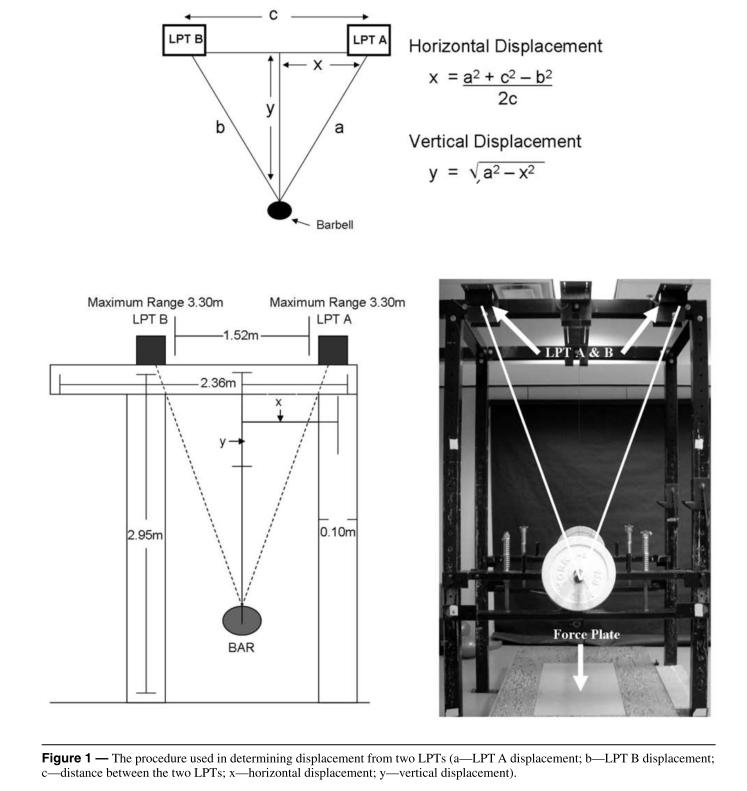

The key part here is the use of a force plate. The tethers are inverse mounted and it just does trigonometry to determine position across time. Both this method and the method demonstrated by Lake involved force plates. There's really no getting around actual measures of force. To put it another way, trying to use VBT devices to measure force or power is like using a thermometer to measure rainfall. Ok, not that bad, but sort of.

Another point worth mentioning is that the trigonometry used with two tethers is achieved all the same using GymAware's technology. Rather than measuring the lengths of the side of the triangle (with one unchanging known side length) determining the angles within, GymAware measures one side and an angle which gives you a measure of vertical and horizontal position (the other two sides of the triangle). All that shade you been throwing on social about trig, and now it's actually kinda useful ain't it? Trig is useful folks. Build a staircase.

It's important to point out that Cormie et al and Lake et al's method do stand in conflict to one another. To some extent, Lake is probably right that center of mass is the "real" variable we should be measuring (kind of like how work is the "real" variable for volume). At the same time, Lake does not sufficiently explain how they determine the center of mass. This isn't necessarily impossible either if you apply something like segmental densitometry (for example, DEXA gives limb weights). Without taking sides here (Lake vs Cormie), the important parts are 1) both of them point out the necessity of a direct measure with a force plate 2) both research groups have authors that have done a lot of research on powerlifters, so they're pretty damn rad.

Accelerometers


Accelerometers seem to bridge this gap to some extent, when the right inputs are used. The issue is Force. Force is a product of mass and acceleration. If we return to the issue as mentioned by Garnacho-Castaño et al, inertial sensors would seem a likely solution. If I haven't hammered the point home yet, while accelerometer technology has failed to perform on some fronts, it could be the missing link we're looking for. This is especially pronounced with power movements.

I've talked before about how you could theoretically determine velocity when an accelerometer is attached to a fixed point if you know the lifter's height. It's a rough approximation and relies on relatively normal proportions of limb length according to height and the mechanics of exercises being relatively comparable across a broad population. That method would require a certain amount of machine learning or constants and manual inputs of the lifter. At a minimum, I would think height and weight would be important to determine force and power. That said, if tethered devices clearly excel at measuring bar velocity, then they're probably the right tool for the right job.

Banyard et al down at Edith Cowan Uni used the same method that Cormie et al used and took GymAware and PUSH head to head in one of the most comprehensive comparisons. Again, these comparisons are made with a dual tether and force plate system:
Notice this is only figure 3 and 8. You should see the rest of them. Some have insisted that the difference between actual power and GymAware's power is only 10 watts. I'm seeing 100 watts. Follow the link.
If your main take away from this is that PUSH is hot garbage and GymAware is overpriced because it measures what it says it does, you're missing the point. The point here is that I'm not sure why these are currently two separate products. A combined approach using both a tether and an accelerometer could still be affordable (assuming GymAware doesn't set the price), you'd likely see additive value. Force plates are almost out of the question.  In order to cover the size you'd need for a simple movement like a squat, you're talking about an upfront investment of $600 minimum.
Just do the math. If the cheapest tether device is $200, and a force plate set up would cost $600, that's like 4 red competition plates you can't buy.

I haven't been paying terribly close attention to PUSH, but it would appear they're actually serving their market pretty well. They've implemented a new system that uses some video processing in combination with the sensor to collect different metrics. Again, this really doesn't matter for our purposes because, well, barbells. If you are using the PUSH as a powerlifter, one great feature they've implemented is velocity cut off notification. That makes it decent for hypertrophy work (because lighter=faster), but maybe not a strength. The only other VBT device I can think of that has attempted to add another input (IE: video, displacement, etc) is the Form Sensor. However, Form's altimeter really only helps to improve vertical velocity as far as I know.

Approximations aren't all that bad

Some accelerometer systems are getting their estimates of power based on the combined input of load and body weight. This sort of works, but we have to recognize it is an approximation. The issue with most accelerometers in the end is that they tend to be thrown off by sudden changes in direction, jarring not related to the movement, and Germanic talismen inscribed with the correct order of runic scripture. Ignoring some of the inadequacies there, approximations aren't too bad. 

A good example of combined measurement and constant (manual input) measures is the Powerlift App. When you break it down, the app functions as a video stop watch. It takes a video that you use as a visual reference point, you input a range of motion for that movement (which hopefully you measure appropriately), and choose start+end points for the concentric part of a movement. It's actually pretty good at it and has been validated in a lab. All the app does is convert the start+end point frame count to determine time, dividing the ROM by that time to determine mean velocity. You're not going to get peak velocity.
Side note: Powerlift is unlike many devices in that it actually stores correlations of load and velocity, as well as many other useful funtions. Most device manufacturers could take some tips from Carlos. Technically some do this, but is a sort of way that can only be reference manually - far from optimal. 
Again, with combined measures and inputs, you can improve this further. For example, if you were to take the average of your ROM from all loads over 90%, you could improve reliability near 1RM distance. You could also manually input your MVT in advanced options, but for sake of fidelity it's probably better to only use ROM input from another device you trust and video an MVT rep to keep it relative. 

Why it Matters: Science, Theory, and Methods


When I say the science, I really mean more of the mechanics - the sort of rules that things obey. There is something troublesome about scientific training. Firstly there's the fact the science does sort of exist in a vacuum. The protocols employed by science are commonly used to elicit a response, to tease out a marked difference or similarity of one treatment versus another. It really doesn't matter if it's a realistic training program (let's pretend that's the only kind of sports science for this), but one that emulates enough elements of real training protocols but has a magnitude large enough to elicit a response. Basically, most of these programs don't have ecological validity - they aren't programs that would be optimal.

Training theory on the other hand (not "scientific theory") is basically the rationale which we think training follows. This is a blend of what coaches have seen in practice and lab rats have evaluated in a laboratory setting. That connection from A to B isn't always a straight line. For example, the force-velocity curve is more based on the functional characteristics of muscle fibers. It's not necessarily the same thing when we're talking about movement created by multiple muscles and about multiple joints.

Lastly, the methods are how we choose to execute our training theories, hopefully based on the practical applications of the science. Using bands is one such methodology. I've beaten that dead horse long enough though, so let's use Orange Theory Fitness. Orange Theory Fitness markets itself as a science-based weight loss program. It sort of is. If we think of work (joules) as a proxy for energy expenditure (calories), then high volumes of energy expenditure are more obtained at lower intensities. I'm basically saying pure cardio. That's not exactly the Orange Theory Fitness training program. Secondly, there's a significantly greater magnitude of difference obtained through diet. So it's not all bullshit, but science did not divine the right answer to Orange Theory fitness and there's plenty of caveats. But science sells. Even diet programs use that tactic.

Everyone fails at marrying these three elements together, including your gurus, to some degree. With velocity based training, most of that fault comes from the science. I spent this whole article highlighting disagreement. The training theory failing comes from over-expansion of concepts like the force-velocity curve (IE: the training zones). An extension of that carries over into methods. Assuming the force-velocity curve can be made so specific in gross movements could be made even worse with the idea when adding variable resistance.

Putting it All Together


If you own a tether system, stop being so uppity. You have the most appropriate system for measuring velocity, and even that is still subject to error - even more so if it doesn't measure angle of pull. You could probably rig up two single axis system to improve vertical velocity measurement and maybe even track bar position throughout a movement, but there is no consumer level solution yet. Beyond the fact that tethers aren't appropriate for movements in three planes of motion, accelerometers do have additive value to help us better measure simple training metrics - like force, power, and work. We don't have those solutions yet, but that's likely the future. It might seem ridiculous to forecast the future like that, but given the relative utility of Accelerometer-GPS units for field practice, it's not too far off.

Velocity based training is supposed to be a method to quantify things we were making guesses about. Generally, something that's powerful was subjectively fast enough and light enough. I say subjectively because it has to be someone with some authority and experience in developing powerful athletes with movements that best mediate that training quality. That sense of what is powerful is largely a presumption. As much as velocity tells us, there's still plenty we can't nail down. Operating in this unknown area is fine though. We've been operating in the unknown using simple measures for decades. But you should probably stop taking VBT measures of power and force at face value.

#MaybeJustLiftWeights #ButHaveYouReadSUPERTRAINING

Monday, March 20, 2017

A Powerlifter's Guide to VBT Pt 5: Future Directions for Auto-Regulation Training

[Update 5/9/2017] The manufacturers have responded pretty robustly and directly. Some features I say manufacturers didn't have they actually did have - either on their premium account features or through some other way. Other features were already in the development pipeline.

Most notably, Beast reached out and told me they do provide some velocity-time graph features for the first rep of every set - which is useful for analyzing opening attempts or 1RMs. You can export on Beast - again possibly with a trainer account which I don't have. OpenBarbell also debuted a new export to CSV option. Who even knows that OB is coming out with in their version 3 release, if any changes at all.

I'm not going to edit this as every advance in the technology or science happens. I'm hella lazy. So just keep that in mind. I also apologize for the horrible formatting I did. I've tried to correct that.

[Update 5/17/2017] Both PUSH and OpenBarbell seem to have developed through different avenues. PUSH with seemingly more outreach/education and OB with a new build and promise of an updated app. OB is exporting to CSV after a few hiccups with the initial rollout, and it very clearly stores the information on a linked Google Drive account upon successful export.


INTRODUCTION

There are two avenues I'd like to see developed. The first if the most practically oriented, and that's things manufacturers and practitioners can do to bring the technology forward. The second is possible future directions for the research. For the folks on the front line, the obviously more actionable one is on the manufacturer and practitioner end. Without the research to validate our experiences though, we're essentially working by trial and error. I don't mean to fetishize what the academics are doing, but if we were limited to exactly what the practitioners were doing, VBT would probably be limited to the secret strength and conditioning manual of Missouri Football (jokes). There is some overlap between the manufacturers, practitioners, and the research. This is obvious with folks like Dan Baker working with PUSH, Bryan Mann working with GymAware, and Kabuki teaming up with OpenBarbell.

MANUFACTURERS - THE EASY SOLUTIONS FIRST

This is probably the easiest part to sort out. The private sector tends to be rapid about sorting out solutions fairly quickly. The main issue is holding some of these things back due to novelty and propriety. One of the most interesting recent advances in VBT devices that I expected more out of was Open Barbell being open source. This was different than previous devices that tried to meet the demands of the loudest and highest paying voices in the industry. These were namely strength and conditioning in sports, mostly money sports (which powerlifting is not). My original hope was that Open Barbell would have diverse application development that would run awry, much like the Google App store. This has not been the case. Meanwhile, other manufacturers seem to be porting out features that have no direct application to powerlifting and pertain more to speed and power sports.

So what do I hope to see/expect?

Possible Hardware Configuration Changes or Methods of Measurement


This section is full on nerd. You might not appreciate it, so skip to the next subheading.

This is possibly more pertinent to accelerometer systems, but it would make sense to me that additional sensors could increase the accuracy of accelerometer VBT devices. Form Lifting seems to be beating down the right track by incorporating a barometric altimeter. PUSH, on the other hand, tries to navigate the measurement by using accelerometers and gyroscopes. Using this approach, if you can get a signal on the orientation and the acceleration of the sensor, you can derive velocity data by normalizing to individuals with some simple inputs (height, weight, etc) following a basic template that teaches the data processor how to interpret the information. I haven't had hands-on experience with Form Lifting, but it would seem to me their sensor has an advantage that PUSH doesn't: movements where the rate of change in orientation of the sensor and velocity is very low. This is most pronounced in the deadlift, where the rate of displacement of the sensor is slow and orientation does not change to a significant degree. A sensor like Beast struggles with deadlifts for one common reason that many accelerometer systems do: the jostling of the bar after dropping and vibrations. The difference with Beast is it allows the user to purge repetitions. This solution is easier with faster movements like the squat and straight guesswork with a heavy deadlift.

Accelerometer systems only have so many ways to navigate this issue. One potential fix is to change sensor location. This seems to be an area where Beast has the most versatility, advertising itself as both a magnet mounted unit and a wrist-mounted unit. PUSH also uses this method by relocating the sensor for jumps (waist belt mount) and pull-ups (upper arm). Another sensor, BarSensei, seems to build their units to be more purpose driven, with accelerometer systems that are both bar mounted and medicine ball internal. 

The next solution ties into the following to some extent. One issue with the systems tends to be that they are unable to tell their position relative to the whole system that's moving (the body and the barbell). One possible fix is to give it more inputs specific to the user. For example, if the system understands orientation about the human body and how it accelerates at different angles, it could be pertinent to teach it the exact position of those pesky joints. For example, a system that assumes your trunk is 30% of your height, leg is 23%, and arm is 32% could gain from knowing what the actual lengths are so as to know how they are supposed to accelerate about the y component when functioning as a whole system. Form gets to sidestep that issue by utilizing their altimeter, but other systems have the advantage of additional inputs, like asking users to calibrate the system through measuring body segments. This is in contrast to using generalized proportions. This is most important when anthropometrics can garner an advantage in a sport, like long arms aiding deadlift mechanics.

Now that we're headed down the path of calibration, we should talk about calibration. If anyone remembers early GPS systems, they required you to do a calibration process whereby the user spun the unit across two planes and raised and lower the device. The counter-quip to this is to build a product that's fully calibrated and holds it to begin with. This might be a sound philosophy when it comes to smartphones becoming outdated every year, but I generally expect my gym equipment to last longer than that. If I had to replace my iron every year, I'd rent it through a commercial gym rather than owning a home gym. An ancillary issue is the price and/or supply can fluctuate wildly. In particular, Beast has taken forever to create an American distribution location, the price of PUSH has only increased due to increased features and development, Open Barbell sells out of stock inside of a day, and GymAware cost roughly the same as a cycle of steroids so why not go that route anyways (kidding, USAPL). Long story, short: it might be helpful to have a calibration feature built-in on the operator end.

Load-Velocity Mapping Built In


PUSH essentially has this built in, but it doesn't really make it useful. For whatever reason, you're perfectly able to run a 1RM-VBT estimate through an app feature, but that information just stays in your dashboard being as useless as calf raises for your bench press. Instead, you just get this feature that lets you dictate a really broad range of velocities for a specific training quality (strength, speed-strength, etc). Below is an example of PUSH's built in 1RM estimate test.


I would like to see a feature that allows you to map Load-Velocity. Ideally, I would like to see the app conduct a reverse lookup on a build-up set (as you're trying to find your working weight) and return an approximate estimate of your %1RM. Even better would be the ability to set a %1RM and have the device alert you when you're within acceptable tolerances of the corresponding velocity. With this one feature, half the reason to use templates like I do disappears. Chances are, if it's something I do in MS Excel, there's a really easy way to make it happen in an app.

I don't shame people often, but the industry deserves to be shamed on this fact. Some VBT devices have been on the market for years now. The research and practitioners have been pretty clear on the need for L-V tables to make it individually actionable. Instead, manufacturers have sidelined this simple implementation for others. This is a letdown, especially for manufacturers that have had e1RM features since day one. Failing to capitalize on this relegates some VBT devices to cocktail party tricks that have little to no effect further down the road.

Update 8/28/2017: Even though I've railed against video analysis systems in the past, the Apple app Powerlift actually does this. Furthermore, it has been validated by Carlos Balsalobre-Fernández. There are some limitations, but it's still good in a limited way. To set up your load-velocity profile, you have to know the length of the movement. To get this, I cheated and used the readouts from Open Barbell's ROM measurement (btw: my squat is 666 mm). You can build out your load-velocity profile and then measure the velocity of individual reps. If I were using it in real time, I would probably just ramp up to 80% actual 1RM, measure the velocity, and use the estimate + basic algebra to figure out the day's 1RM and the working weight for the day. This might not be optimal given recent findings, but I could see this working it's way into the app shortly.

Also, I wouldn't get hung up on the fact that Powerlift's velocity differ from another device if you use one. What's important is reliability, not so much accuracy. The key part is to try to conduct your 1RM predictions from the same camera angle, height, and distance as your load-velocity mapping session.

Load-Exertion Mapping Built In


Likewise, a Load-Exertion (L-E) or built in rep to failure (RtF) table would be just as useful. While I tend to follow velocity loss, there are practical limitations to this simplistic approach. A built in L-E table would give you a good indicator to follow in real time, alerting you to when you're 1-3 reps away from failure. A L-E table establishes what your last rep in the tank, 1-3 reps left in the tank, and so on. Rather than working based on velocity loss, which gives us a very rough guideline, we can dial it into alerts based on how far away from failure we want to be: 1-4 reps depending on the training goal. Granted, RPE ratings essentially do this for us, but this feature alone could increase the cross talk between RPE and VBT. This provides a very clear objective read on reps in reserve that can be used in real-time for VBT users or to validate RPE's assertions on their ratings.


To make L-E feature built in, all that would be required would be RtF sets at two intensities, like 75% and 85%. Those RtF sets could also feed forward into e1RM tests to establish MVT and a more accurate estimate of 1RM.


How about this for a really easy feature: any time you set a new record low velocity, ask if the user wants to designate that as their MVT. Make it something that can opted in or out of, just in case it wasn't a full rep, it didn't meet the criteria for a technically proficient lift, or was purposely moved slow according to tempo prescription.

The "Velocity Zones" Sucks


This one thing is the most important factor IMO to make VBT data fluid and actionable.

Firstly, the velocity zones for are very dependent on the exercise and athlete, depending on the training outcome. You could probably find ideal zones for different exercises for different training qualities for different types (most specifically heights) of athletes. This sounds very time-consuming though and doesn't really help the user. KISS: keep it simple, stupid. That, or I guess you can exploit the fact you have a user database with self-selected data, do a database analysis controlling for height and exercise classification, and multiply it by the squared cosine of making a simple solution harder than it needs to be.

This one thing is the most important factor IMO to make VBT data fluid and actionable.

Granted, there is a way to do this through program creation with some apps and webportals, if you can get over the fact that every system that has a program creation guide as rigid as frozen dog poop. Here's an idea: let me designate the velocity zone myself while using the app. Specifically, let me choose a velocity, plus or minus a given percentage of that velocity for an initial target, and an acceptable stopping point (either a specific velocity or a certain percentage of velocity loss).

Surprisingly, Beast for all it's
lackluster does have this simple
feature. Not exactly on the mark, but
why is this not common to all?


It seems pointless, but when you consider that rows and pull ups have a high MVT, according to the velocity zones, you can hit a 1RM without ever really working within the "absolute strength" zone. If we had this one feature, you wouldn't have to see the screen for real-time feedback. This one thing is the most important factor IMO to make VBT data fluid and actionable. I'll keep saying that in hopes that some manufacturers pick up on the point that this needs to be a basic feature.

Athlete Monitoring - Daily Readiness Testing


Take for example a traditional Sheiko program. Something that has you squat for a certain number of reps, gives you a brief reprieve by benching, then has you do an assistance version of the squat. If you have a very, very clear training priority in the day (squat, in this example), you want to know how beat up you are. One of the more popular ways of checking your daily readiness is by doing a squat at a standardized load. I usually use 60% of my last official 1RM (not my daily 1RM). I call this my "cold start" since I do it first without any warm up or practice reps (maybe air squats or some body weight variant). If that weight moves slower than my L-V tabled velocity, I know I'm carrying a bit of fatigue around. This doesn't stop me from training, but it prepares me for what to expect. If it moves faster, I can probably stack more plates on the bar that day.

Not terribly recently, Dan Baker suggested a standardized load of 80% 1RM IRC. The smallest worthwhile difference in determining deviation from readiness was 0.04 m/s difference from baseline. If you can move that faster, you're stronger (at least that point in time). More than 0.04 m/s difference in terms of drop in velocity means fatigue is inhibiting your readiness. This seems to come from his coaching experience and possibly data from his previous studies (the Oceania strength and conditioning community is awesome like that). YMMV

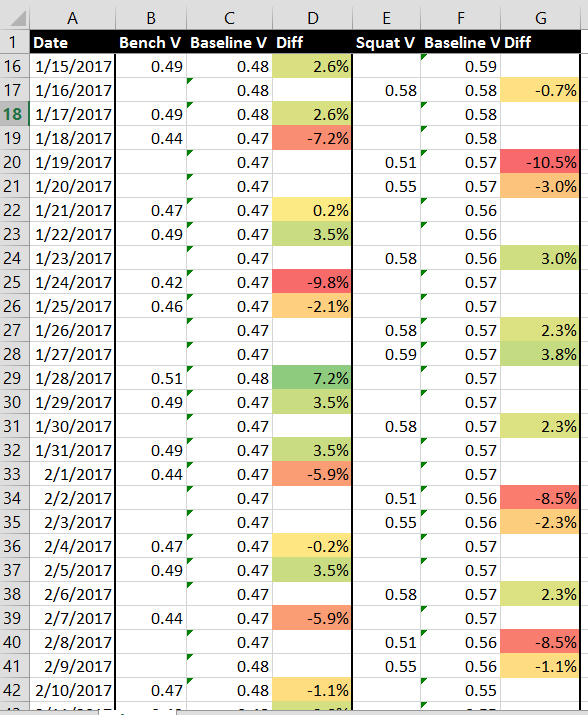
With enough measurements, you should have a baseline reading (think of it like a rolling average). With that baseline, you'll also have a gauge of what is abnormally above or below your baseline. This is the same kind of principle that Heart Rate Variability uses on a global level, but this gives you a direct read on local neuromuscular readiness. Again, this is something you can do through Excel using something like basic Z-scores or percent difference from baseline. Here's a fictional example:

Standard traffic light system. Green means increase training
load, yellow means normal training load, red means decrease
training load. Arbitrarily set at a difference of 10%

The hardest part of athlete monitoring is finding a way to make it unobtrusive and have additive value to the training process. It's already a bother to make an excel sheet to accompany an app to accompany a device to accompany a barbell. How is this not a thing? Manufacturers that want to sell their product like it pertains athlete monitoring should put something in the fine print that says, "but you figure that part out on your own, hoss." 


Graphs Against Time


Given the amount of samples most of these devices collect per second, it would be really helpful and plausible to have velocity-time graphs or displacement-times graphs much like what is shown here:

These seem minor, but in powerlifting it really helps validate struggling areas of your lift. For example, a change in the slope of displacement over time can show you the slow parts of your lift. That slow part of your lift is likely going to be a weak point or sticking point. Depending on the location and your development, you can overcome that sticking point by "strengthening the zone" by focusing work directly in that weak range of motion. Another way to breaking past it is by developing acceleration before that point so more acceleration can be developed to "power through" that sticking point through inertia. 

Granted, this is something you should see during the course of training but gives you a ruler to measure it by. Objective feedback is one of the selling points of VBT. There are likely some practical limitations here like the throughput of information that can be sustained through Bluetooth, but I see this information be utilized more after the fact during set review. This does not need to be a real-time feature, making this still a plausible feature.

Added Value: Tandem Video Recording with Data Overlay for Coaches


I have to admit this is something GymAware already does to the best of my understanding, along with graph overlays. It seems like online coaching with set review is fairly common. Advances in the internet and mobile devices have facilitated the process. I'm all for it, within reason. For coaches that see added value in the velocity data, this helps centralize all the important information by giving the mean velocity of each lift as the lifts are performed. This would be especially helpful for 1RM attempts, RtF sets, and L-V mapping sessions. I highlight those because those three things could throw off the whole accuracy of V-%1RM plots and potentially over/underload future training sessions. Below is an example of video synced with mean power from Dan Baker:


Even on the individual level, this allows the athlete to understand potential causes of velocity inconsistency, such as intervals in which they brace, range of motion contributions to velocity, the magnitude of simple form breakdowns, etc. Unless GymAware has copyrighted this specific tool, it seems easy to implement. This is something people commonly do through two different applications and the feature would merge the process and consolidate the information.

Cut the Fat: Microcycle Management for Coaches


No, I don't think this being able to create and push training plans to athletes is worth a damn. It seems like everyone except for the barebones manufacturers want to provide this. However, it's limiting to the point of being useless. A good example is one manufacturer automatically prompting you to follow the training plan as soon as it starts. Needed a build-up set to figure out what load is appropriate for your working sets? Too bad, that single plate warm-up just counted as one of your 6 working sets. There are plenty of scenarios where this level of inflexible management just performs poorly. Any workout program that's so rigid that it doesn't allow you to take a dump mid-workout to prevent pooping your pants during your squats is a bad workout program - I don't care what it adds to your total.


One example of program creation from Beast


Part of the whole point of auto-regulation is that you're not following a play by play script. These program features attempt to constrain the training process that is meant to be boundless. So I'll make it simple: you don't need to remove this feature, but there are zero reasons to buff it out. If there are recreational users that think it's useful, freeze it's development because it's a waste of time and resources. 

The market is already glutted with program creation and distribution products without VBT. No one's buying the product strictly for this point alone. Recognize it for what it is: fluff. I rate this feature a flat out zero fucks given. Here's a shorthand program that will get me through a session with VBT:

Comp Squat: 6+/2@0.42 m/s, stop @ 0.32 m/s
Close Grip Bench:  @0.54, stop @ 0.30 m/s
Pin Squat: @ 0.6 m/s, stop @ 0.33 m/s
(4x10 follows)
Ab rollout, shoulder external rotation, pull ups

That alone gives me 90% of what I need to know and the other 10% I want isn't supported by any program management tool I've seen.

Air Cast and Mirracast

[Edit 8/8/2017: If it works with Apple, you can cast it. Just make sure you change your screen time out. That said, this actually hasn't been super helpful now that I've taken it for a test drive. I much rather prefer to have some sort of mounting system. Especially when it comes to bench press and I'm staring straight up.]

This is not really a feature that needs direct support. As far as I know, you can do this on both systems, possibly with a little bit of ingenuity. Screen-casting (Air Casting on Apple and Mirracast on Android) solves the simple problem of using the information in real-time. This might seem ridiculous, but it is quite an obstacle to finding a clear way to suspend your iPod in plain view during your squats and bench presses. Granted, a Perchmount makes this easier, but the only way I've gotten this to work with squats has been good ole 2x4" ingenuity. This is probably limited to users that lift in home gyms, but it's something to consider for people that struggle with using real-time feedback to regulate their sets. 

This whole casting idea means less if manufacturers make initial velocity and end velocity prescription more accessible, but there is some additive value of buffing that up with something like delay video casting with metrics overlay on the video. Video demonstrates a simplistic system:


Data Export (Plus Import) and Cloud Based Syncing


This is something some manufacturers already provide. PUSH exports to CSV, which functions the same way as Excel. This seems like a minor thing, but depending on what you're using your device for it can be annoying to manually transcribe information. PUSH is unique that it gives the extraneous details, like time spent concentric/eccentric, force, and other things that aren't available in the user interface. As far as I can tell, Beast doesn't do this. OpenBarbell just made an update that uses your Google login to sync, but as far as I can't tell it's not syncing anywhere where a user can retrieve it and the only viewable data is stored locally - a problem across multiple devices.


Export as shown on PUSH - probably the most underrated feature

The most interesting idea would be removing long-term data analysis from the realm of manufacturers' web portals and allowing hand off to others. There are plenty of platforms that currently do this, like AthleteMonitoring.com and Fusion Sport. Some of these platforms have opened avenues of cross integration to allow automatic syncing (rather than manual inputs) of pertinent athlete monitoring metrics, like heart rate variability. Reactive Training Systems has developed a system that performs according to the metrics Mike T thinks are important, like resting heart rate and subjective questionnaires. It's helpful to note that this service is free to use regardless of whether you work with RTS or not. It does simplify the process. This saves you the trouble of developing your own data collection system and figuring out the analysis yourself. The problem with TRAC is it's developed with RPE in mind. The only other game in town that's powerlifting specific is MyStrengthBook, which is more training analysis than it is athlete monitoring. Regardless, neither currently seem to think of training in VBT terms. If you buffed out your VBT process to include multiple RtF sets alongside referencing velocity to %1RM, you could potentially create a VBT to RIR translator, making TRAC a usable training log.

The truth of the matter is there is no good VBT training tracker for powerlifting. This is to include among the manufacturers of VBT devices. Manufacturers need to abandon the idea of managing their own data when there are plenty of others whose sole attention is managing the training that can do the job better. The first training analysis to take VBT seriously and integrate or import velocity data and provide effective long-term analysis is probably going to a get a lion's share of the VBT consumer's market. The flip-side of that market is it's likely smaller than the RPE market. It would seem to me the easiest way forward would be to exploit the features of MSB/TRAC and translate VBT data into RIR as a proxy for RPE, then release the extensive data under the handle twitter handle Guccifer to satisfy our Russian periodization overlords.

Here's a walkthrough for data export on GymAware's portal:


And finally here's a video demonstrating how you export data on Beast and Open Barbell:


[update: since the original post, Beast and
Open Barbell has added this feature. #TomHanksVBT_Hero]

RESEARCH AVENUES

This isn't nearly as easy. It's easy to find the shortcomings of manufacturer's for current consumer requirements. It's easy to list out the things we don't know. It's hard to list out the things we don't know that we don't know. One of those Donald Rumsfeld known knowns, known unknowns, and unknown unknowns things.

So here are the obvious things we can talk about that we need to pursue on the research side of the house. Most of this is from the interest of strength training and powerlifting, not power development which seems to be better covered in the literature. For the sake of simplicity, this is the short list of things I'm selfishly interested in seeing studied for current needs in powerlifting and strength training.

1) Inter-individual Differences: determine velocity characteristics and differences across heights, limb extremities, anthropometrics, gender, etc


This one seems obvious. Taller folks or people with longer extremities are moving over a longer range of motion. This probably has some influence on their maximum and minimum velocity under load. That part seems easy, but the more complicated part would be examining the effect on sticking points during common movements. 

It'd be interesting to see how well our understanding of the literature holds up for training women and lighter class lifters in terms of velocity. It seems to be internet slapstick to cite that women and lighter lifters have differences in training load and reps at a given %1RM. Given the granular detail VBT provides, it could be helpful to see if we can characterize these training differences in velocity terms (velocity loss, mean velocity, MVT, etc).

2) Intra-Individual Differences: changes in velocity over time from different training modalities

We kind of have a working idea of this through the force-velocity curve, but this doesn't typify the differences in training that any practitioner has seen.

Credit to Haff and Nimphius

Everyone that's worked with a new athlete while running VBT (even if only for observation and not auto-regulation) have typically seen changes in MVT across time, usually corresponding with a change in strength (1RM). I've also seen this difference in speed trained athletes that tend to have higher MVT's than traditionally strength trained athletes. There's probably some interest in finding some middle of the road types of folks, whether that means a type of athlete or a type of training. In that selfish powerlifter way, I wonder how a conjugate method F-V curve compares to other powerlifting training modalities.

Furthermore, a mechanistic view on MVT would be interesting to see. It would seem there are many factors that could contribute to MVT dropping over time, such as changes in form, bar path, and other kinematics, but part of me wonders what the absolute floor to MVT is and whether there is a way we can predict the bottom end of minimum velocity threshold or the absolute minimum that minimum velocity threshold can move. There's probably some energetic or fiber type contribution that would also aid in explaining that, but I feel like that's a far reach and would not significantly impact how I use VBT in training.

3) Characterize particular movements: DEADLIFTS, rows, overhead presses, pull-ups, and variants of the primary lifts

[Edit 8/8/2017 - The Spaniards covered 4 different bench press types: regular bench, bench throws, bench press from pins, and bench throw from pins. They appear to be doing another article on the subject.]

[Edit 8/28/2017 - This has been fleshed out even more with different squat variations, plenty of stuff on pull-ups, and prone rows. The general trend seems to be that when the eccentric and concentric part of the movement is separated, there's increased accuracy and reliability. For many of these things, it's just a matter of the research catching up to what the practitioners know to be true. There have been circumstances where it appears researchers have really challenged our understanding of VBT.]

First of all, we need to recognize that deadlifts quantifiably behave differently. Deadlifts are noticeably absent from the research when it comes to VBT strength training. I get it. You can't publish an article with no real results to show for. It might be more productive to make comparisons across multiple exercises, both in the context of low-moderate intensity for power development and high-intensity for strength development.

Rows and pull-ups (for devices and methods that support body weight movements) are another confounder. When I did measure pull ups, one thing I found was that the velocity floor seemed higher (MVT around 0.42 m/s, far enough within accelerometer performance limits) for rows than it was other exercises. This seemed to be the case for seal rows without resetting to the floor, Yate's rows, and Pendlay rows. Normally I would contribute this to my lack of emphasis on upper back strength (I know I'm not only PL that seemingly negates upper back in favor of comp lifts), but according to folks like Dan Baker, this tends to be the case with his Rugby players that spend a lot of emphasis doing bench pulls.

I can tell you bench, squat, and deadlift general MVTs. I can't tell you overhead press MVT's and only have a rough understanding of velocity behavior across a set. In particular, the first rep and any "broken" reps (short stops at the bottom on successive reps) tend to be lower velocity. I generally don't care about this too much, but it needs to be said since there's some carry over to WL.

A hypothetical graph of %RM-V behaviors
Having a general understanding of how to treat assistance movements would really helpful. For example, if you knew that close grip bench press and Spoto presses were only mildly different from regular bench press, it would be helpful to characterize the magnitude of difference in the same way we generally say bench/deadlift and squat MVT's are 0.15 m/s and 0.30 m/s. It would seem to me that the main difference in the %RM-Velocity plot could be the slope of the line, the intercept, and the MVT. A picture of this would be appropriate and is shown on the right. This is a simplistic explanation, and it's likely certain factors tends to change different parts of the relationship.

This is generally what I find for me and what I've found with a few clients when using VBT as an observational metric, not an auto-regulation metric.

[Edit 8/28/2017 - Actual graphs of variants of the bench press, pin press, bench throw, and bench throw from pins.]
[Edit 9/5/2017: The same graph as above recreated with overlapping trend lines using Desmos online graphing calculator]


4) How rep count schemes and rep tempo modifiers affect concentric velocity


This is somewhat covered in the non-VBT scheme of research. I mentioned in the past the idea of using cluster sets to maintain velocity at high intensity and increase set volume. Myo-reps are another method which acts roughly the same way but is used to increase volume for hypertrophy/work-capacity appropriate loads. The mechanistic approach is helpful, but a good question would be whether this training modality is meaningful.

One interesting development in VBT was a study that focused on a VBT program vs an eccentric VBT program. Spoiler alert, there were no significant differences in 1RM improvements in the squat or bench press when comparing training modality. The Spanish VBT proponents have also played with rep modifiers, finding that imposing a pause between the eccentric and concentric improved reliability (something I have found useful). Anecdotally, I'm wondering if this utility can be expanded to include other tempo schemes. VBT has one added benefit to traditional methods of controlling tempo that it can give instant feedback as to whether the stated goals of the protocol are being met, and thereby what the practical limitations are.

Until we have a clear understanding of these things, we're shooting in the dark or we're going to need other methods to pick up the slack (like RPE).


[Edit 8/28/2017: We're getting a little of that now. This shows rest time equated cluster sets and traditional sets.]


5) Comparison showing the obvious superiority of VBT to that of traditional percent based training and rating of perceived exertion


Not necessary, but if anyone wants to beat down that path they're welcome to it. Different strokes for different folks.


CONCLUSION

Most of the things that manufacturers can do to bring the technology and practice forward are very simple. All of the concepts are not new, and many pre-date many of the VBT devices on the market. Bringing VBT to bear in use in the general public necessitates this process. Simple changes like %1RM-Velocity mapping, Load-Exertion mapping, and others would streamline the process and help athlete management. Many of the features that have been fleshed out apply to those that work with "velocity zones" which are too wide to manage the fine processes of strength training. And when it comes to powerlifting we are working with a narrower range of the velocity spectrum than power athletes. This is not because VBT does not lend itself to strength athletics, but because VBT manufacturers have not made their products nearly as accessible to strength sports.

It is my opinion that manufacturers should focus on how to manage the training session, not try to fill the role of presenting ways coaches (or self-coached individuals) should attempt to manage training across time. Rather than attempting to do two jobs poorly, they should focus on auto-regulation mechanisms internal to the system (via the app) and outsource mesocycle data management to those that have the potential to focus on it better. I've linked to multiple places, but for powerlifting specifically, this is best handled through MyStrengthBook or TRAC. 

The science still has a few questions to answer. Most of these relate to how we understand velocity as a marker of intensity, exertion, and fatigue across more movements and variations of movements. Giving us an understanding how this varies across different individuals or across an individual's development would better help us understand VBT beyond specific practitioners' experiences. 

Friday, March 3, 2017

A Powerlifter's Guide to Velocity Based Training Pt 3

My n=1 Experience and Best Guess Practices

Life pro tip: Enable text to speech on your phone (iPhone or Android) and have that guy read the article to you. I do this all the time with Stronger By Science articles. Read smarter, not harder.

TL;DR

  • VBT isn’t about speed-work, but you do have to move with fast intent and consistent form and kinematics (IE: either squat with or without a stretch reflex, choose one)
  • Load-velocity profiles help translate %1RM to velocity. This relationship appears fairly stable over time and helps prescribe intensity according to what the athlete is capable of that session.
  • VBT 1RM estimation allows an athlete to assess 1RM submaximally, sparing the potential fatigue and programming considerations for AMRAPs and 1RM testing.
  • Velocity loss within a set or drops in opening/set average velocity can be used to target strength or hypertrophy adaptations and establish fatigue thresholds. This should not be confused with attempting to limit fatigue unproductively.
  • How to improv a VBT workout if you’re trying to familiarize yourself with it
  • Next week I'll actually drop some VBT programs

DISCLAIMER

I should start this by saying that the Spaniard VBT proponents are Gonzalez-Badillo, Medina, Marques, Pareja-Blanco, Rodriguez-Rosell, Gorostiaga, Izquierdo, Ibanez, and probably a few others. These individuals along with Cronin, Mann, Baker, and others to some overlapping extent (Haff, Kraemer, and Stone come to mind) are the forefront of VBT research. I say the Spaniard VBT proponents not as an insult to the Spanish academics, but ease of explanation. While I try to use some learned reasoning when I write these, I won’t pretend like my style is academic. If they were academic, I wouldn’t be dropping links to Murderbot Productions’ videos alongside journal articles.

INTRODUCTION


               It’s entirely appropriate to say that most of the benefits of using velocity based training (VBT) apply most appropriately to training for power and not powerlifting (PL). Luckily, there’s enough overlap between power and strength training since one tends to be programmed to potentiate into the other that we can still glean some utility out of it. I’m not going to make grandiose claims VBT for PL is going to prevent injuries, add kilos to all your lifts, or that all other methods of programming pale in comparison. My intent with the whole series is to spur interest, increase participation, and create discussion about VBT for PL. I do not claim to be the subject matter expert on VBT. I’m just someone with an interest in VBT and powerlifting trying to make lemonade from some lemons.

THE RATIONALE OF LIFTING FASTER


               If you intend to get the best results with VBT, one of the general things you might have to get used to is maximum intended velocity, or moving the weight as fast as you can with sufficient form regardless of fatigue. You're not attempting to game the movement. You shouldn’t be accelerating the bar so much that you’re bouncing it off your back or throwing yourself off the bench (squat and bench). Trying to move a heavy load as fast as possible sounds like a training obstacle, but when you consider that we’re talking about loads that are innately slow to begin with (EX: 80% 1RM loads), the velocity difference from as-fast-as-possible (AFAP) to self-selected pace is markedly similar to the naked eye. The Spanish VBT proponents found that moving loads with fast intent in the bench press, AFAP subjects were seeing an 18.2% (±11.9%) increase in 1RM versus 9.7% (±7.9%) for a purposefully slow concentric group. The point of this is that there is more than one reason to move the load as fast as possible while still maintaining technical proficiency and it extends beyond just enabling VBT utility. I won’t over-emphasize this point though, this should be considered more on an ancillary benefit. As usual, Greg Nuckols makes some very fair points on this, which I have no intention to cover, but every intention of linking to. This sort of runs counter to my assertions about the conjugate training's approach to speed work, but speed work in that case is often relegated to lower intensities. The point here is any intensity moved AFAP will have better gains, so why bother just limit it to the light stuff? There are time under tension concerns for practicing VBT, but that's a whole other can of worms. 

               I should also emphasize that some amount of consistency in form and technique is also required. If you’re going to use the stretch reflex from touch and go or bounce out of the hole, you need to be conducting this when you attempt to compare past performances to in-session performance. Generally speaking, including a stretch reflex does come at a detriment to the reliability of the measurement. If you change your technique or your form, you might find a disconnect between prescribed velocity and intended load. This will be covered in more detail later in the article.

OBLIGATORY SPEED WORK SECTION

              You can skip this if you don't care for conjugate method circle debates. 

               As I’ve said previously, I’m not a big believer in speed work. Many others have figured out how to get it to progress their training, but I haven’t seen any tangible improvements using it. Given that disclaimer, Louis Simmons popularized the idea and tends to suggest speed work in the confined terms that it increases your force output by spending equal emphasis in progressing the contribution of mass and acceleration. Louis Simmons seems to espouse the generalities of the force-velocity curve without regard to individual differences, differences by movement, etc. Maybe in private practice this isn’t the case, but the blanket coverage is to just aim for 0.70-1.0 m/s in the bench press, 0.7-0.8 m/s for the squat, and 0.9-1.2 m/s for deadlifts. Matt Wenning, on the other hand, tends to recommend anywhere from 1.0 to 1.2 m/s.

Force output is better attenuated by mass than it is by acceleration, but it’s not absolutely clear if there is some ancillary benefit to training within this range. In terms of force, the outputs don’t match the end result – but that might not mean anything. PUSH allows you to see force on exporting from the web portal, so the feedback is fairly delayed. Form Lifting also gives you force in pounds of force (Newtons be damned). OpenBarbell does not calculate force.


Force by percent of 1RM on a straight bar deadlift and a hexagonal deadlift.3

               Without injecting my opinion, there are some people that are still seeing improvements out of this method. One method of determining the most appropriate load via force output would be a Force-Load (F-L) profile, Force-%1RM profile, or you could just use the rigid speed zones. If you want an F-L profile, use a sample of 5-8 sets with 1-3 reps in a different zone of intensity - not much different than Load-Velocity or Load-%1RM profiles. Most devices don’t get instant readouts of force since it’s a calculated metric, not a measured metric. Once you identify your optimal force zone, you can likely use that velocity or load as a reference point in future workouts under the presumption that’s where the best training effect comes from. There is something to be said that training force output indirectly via below peak force output helps create that adaptation. I covered this in the previous article, so let's stop beating this dead horse. 

1RM ESTIMATION


Mladen Jovanovic and Eamonn Flannigan have an excellent review article on researched applications of VBT. What’s even greater about it is it gives very specific details on how to implement it. Even down to the detail of the formulas that are used in MS Excel. Both have an online presence or lecture on the topic of VBT in a way that has a high amount of utility to powerlifting. To summarize it easily:
We have recommend measuring mean concentric velocity at 4-6 increasing intensities of load ranging from 30-85% of actual or estimated 1RM to estimate load/velocity profile. To estimate 1RM for an individual, coaches need to know the MVT of the exercise which could be assessed through traditional 1RM test or reps to failure test.
               This is essentially a two-part test. My current practice is to leave a week free from training and conduct a load-velocity profile, followed by an AMRAP to determine minimum velocity threshold (MVT). Minimum velocity threshold is your typical grinder rep. Generally speaking, the velocity of your last rep in the tank at 75% 1RM and 100% 1RM are similar. An AMRAP is the more feasible way to go, but I’ve found it’s helpful to update your MVT whenever you see a measurement that was slower than one you performed. This is not to say that I’ve actively sought out to train to failure, but it happens often enough even when trying to limit fatigue through things like VBT (for example, hitting ~92-95% 1RM for singles for 8-10 sets). On the rare day that I do max out, it’s essential to get a measurement because that is the direct measure I want. This works differently than conducting weekly AMRAPs because it’s an incidental part of the training process. I won’t say it’s the most accurate way of progressing your training (at least no better or worse than adjusting training max off your rep maxes), but it’s accurate enough to be functional.
AMRAPs usually function as scheduled auto-regulation, add to or taking away from the training max and influencing training load for the following week. By changing out MVT whenever we establish a new one (AMRAPs at a point of our choosing or the surprise grinder), we implement this progression/regression as often as we deem necessary and affects our VBT estimated 1RM which functions the same as a training max. By using the %1RM-velocity relationship, we can get more granular and adjust our training load day to day.
               One of the more ironic things about 1RM I’ve noticed is that whenever I’ve gotten stronger, my 1RM has gotten slower (so much for velocity based training) and my velocity at standardized loads has become faster. This phenomenon (strong=slower 1RM) has also been observed by the Spaniard VBT proponents. Whereas some people view new rep maxes as a sign of progress, in the VBT context of things I have regarded new MVT’s or a sustained increase in velocity at a standardized load as progress. Velocity at a standardized load would be something like a cyclical check on velocity of 80% of your last known 1RM. If that velocity gets faster over time, you've probably gotten stronger over time. In my mind, a new MVT is more meaingful and is essentially a new PR. The general baseline for the population is that 1RM is near 0.15 m/s for the bench and deadlift, and 0.30 m/s for the squat. If your MVT isn’t near that on the device you measure it with, you could just chalk it up to measurement error. As long as your device is reliable, it shouldn’t matter.

Let's make sure we're comparing apples to apples here. Because someone hits 1RM on their squat at 0.3 m's and someone else hits 1RM at 0.26 m/s doesn't mean by default that the slower person is stronger. It's very specific to the individual. A better comparison is that someone that maxes at 0.3 m/s in a cycle is likely stronger by the time they hit a max at 0.26 m/s later. 

               Some people have advised conducting a VBT 1RM test before a workout to serve as a warm up, then conduct a prescribed load based on that estimate for a given number of sets and reps. I don’t think that’s appropriate for reasons I will explain in load-velocity profiling. Doing this test appropriately (not rushing through it and biasing the test) every session should extend your session in the neighborhood of 30 minutes. I would argue this is not the best use of training time.


AN ASIDE ABOUT BUILT IN 1RM TESTING


               This is a rant. You can skip this. It’s important to mention that some devices have apps with built in 1RM testing. There are multiple issues I’ve found with this. 

1           These tests seem to be inflexible if you’ve conducted a 1RM test before. It will base the loads that map your 1RM estimate on the last estimate. This is a big issue for powerlifters who have a gap between their sumo deadlift and their conventional deadlift. My sumo DL is 25 kg higher than my conventional. Because I made the foolish mistake of testing my sumo DL with the deadlift VBT-1RM feature, it prescribed sample loads based on my sumo DL 1RM estimate. This means rather than making the estimate from loads of 40% to 80-85% 1RM, it’s shifted it to around 50% to 90-95% 1RM. This isn't the worst, but I'd appreciate the flexibility to delegate load for testing myself. There is no option to test a different type of deadlift through this feature. And god forbid you ever mess up during the test and it somehow adds 50 kg to the estimate. There could be no going back. Ever since one app update removed the ability to change the prescribed loads, I've calculated the VBT-1RM estimate manually.

2             Rather than following the protocol described before, it assigns you to conduct 5 sets of 3 reps. This seems like an arbitrary call here, but I don’t see the purpose of hitting 85% loads for three reps to map the estimate. It’s extraneous work that may not be necessary. You can complete less than 3 reps, but the chances of the app returning an error instead of an estimate increases. Additionally, it might be useful to map 1RM using more than 5 sets (and therefore 5 different intensities), something I’m trying to transition towards. I’m also entertaining the idea of shifting the starting intensity to 55-60% 1RM since I’m not very concerned with what the corresponding velocity for 40% 1RM is.


3              Part of the reason I don’t like this feature anymore is because it’s a black box. You perform a bunch of inputs, it does some mathimagic, and bada-bing bada-boom, you have an answer. Not an explanation, just an answer. I don’t know if it’s averaging velocity amongst a set or if it’s using a maximum value. I don’t know what the confidence interval is (95% or 90%?) to derive the same answer. I don't know the standard error of the estimate. If I can’t reproduce the answer, I don’t know if I should trust it. And I’ve had some estimates that were off by quite a bit.

4                I believe it uses generalized MVT’s. This can both shortchange your estimate and determine a value below your actual 1RM or it can overestimate it and prescribe you death by bench. If your 1RM is faster than 0.15 m/s for BP/DL or 0.30 m/s for a squat, it’s certainly SkyNet becoming self-aware and trying to kill you with a barbell. If you’re slower than those velocities, the gains goblins are trying to pull one over on you. It shouldn’t be off by that much, but it might be off by enough to affect your training.

All and all, it’s a nifty feature and I’m glad developers are focusing on this. It would be more helpful if load-velocity profiles could be an integral feature. It would certainly make autoregulation easier and probably eliminate the needs for a spreadsheet in training. So far as I have seen, one bar speed tracker has attempted to do this. The app Powerlift stores your load-velocity profile from a previous session. Once stored, you can do a rep at any load and it will estimate what %1RM that was. It's all camera based, which I have railed against before, but they're a relative new-comer to the scene that have implemented such a simple feature straight off the bat. 


LOAD-VELOCITY PROFILING


               I tend to lump load-velocity profiling in with VBT-1RM testing. I consider my MVT measurement, which is required for VBT-1RM testing, a rolling measurement process. If I ever feel like it hasn’t been updated in a while, I’ll go for an AMRAP to make sure I have the most up to date measurement. If it's an exercise I haven't profiled before, I perform an AMRAP. Once I have a load-velocity profile, I tend to convert it to a %1RM-velocity profile. This acts almost like a translator for percent based training (PBT). This way I can still program by %1RM, but train in VBT.

               My current method of doing load-velocity profiling essentially the same as VBT-1RM estimates. Use a minimum of 5 sets at different loads, a maximum of 8. The rule of thumb is to try to decrease the velocity of your fastest rep by 0.05 m/s with each set. Low-intensity loads get 3 reps per set, moderate intensity loads get 2 reps, and higher intensity loads get 1-2. Here’s the example everyone in VBT screenshots:
From the SAME Flannigan & Jovanovic I keep linking

               Once you have those measurements, you’ll have to plug it into Jovanovic’s templates. He recently posted a step by step guide here, but you can also find it in his research review here. Here is a picture to demonstrate, but you should certainly check out Mladen’s article and his training blog.
Guess what? From the same article. Notice this profile is beyond 5 sets. Increasing
your sample size might yield better results. 

               It’s important when you do this that you do practice sets. This is different than warms ups. Practice a set at your starting weight and move it as fast as possible (again, maintaining sufficient technique). If you’re like most powerlifters, you don’t move fast for anything but cake. Practice sets will decrease the error you inject into the system. If you see your second set moving faster than your first set despite the fact it’s heavier, chances are you didn’t practice with enough sets. I prefer to keep the rest times insufferably high. Just like rest times for sprinters, weightlifters, or gym bros distracted by Instagram.

               The next thing is to conduct a MVT test, which is typically reps to failure. The general guideline is to use 75% 1RM or above. My general suggestion is that you use something you can crank out at least 9 reps. Let’s say at 85% you get an average of 0.04 m/s less with each successive rep. If your opening velocity is 0.45 m/s, that means your second would be 0.41 m/s, second at 0.37 m/s, and so on until you approach your MVT. My intuition tells me you can get closer to your actual MVT at 75% than you could at 85%. Alternatively, you could just do an AMRAP at both intensities and take an average of both mean velocities of the final reps. It might also be helpful to use a rep max calculator as a second estimate.

               If you don’t want to do an MVT test, you can use a generalized MVT of 0.15 m/s for bench and deadlift, or 0.30 m/s for the squat. I’ve said before that VBT essentially is snowflake training, so this probably misses the point of using VBT to begin with. Additionally, there is some danger with trying to use generalized velocities for assistance exercises. In my comparison article, I mentioned that I had issues with front squat load prescription. An additional issue I had with my front squat load prescription is that my MVT for the movement is 0.10 m/s higher than it is for my back squat. The result was always that my front squat load was over-prescribed. Mistakes were made.

               One thing I suggest is updating your MVT on the fly throughout your training. This will likely happen often enough that doing AMRAPs become less necessary. I would track when you conducted your L-V and AMRAPs/MVT tests so you know how out of date they are. Maybe you are setting new MVT’s regularly on your main lifts, but a newly adopted assistance lift might not get the same attention – so you might have to implement AMRAPs as necessary, which can be part of your normal training. 

               I do suggest converting an L-V table into a %1RM-V table once you have an acceptable estimate. I was skeptic about the stability of this, but decided to guinea pig the assumption after establishing a 12 kg PR on my bench. I kept the same %1RM-V table. Unlike front squats, it did not kill me ded. After finishing the cycle, I redid the L-V profile, but found no noticeable difference with %1RM-V profile. My estimates for load were off, but my %RM was spot on. Yes, this is a n=1 response, so take it with a grain of salt. All things considered, if your MVT lowers and your L-V profiles shifts with it, your %1RM-V profile should be sufficient. 


EARNING YOUR KEEP: YOU HAVE TO ACTUALLY TRY


               I’m obliged to tell you about the positive effects of feedback. There’s plenty of articles about feedback augmenting performance in team sports, but none of it applies as readily to powerlifting performance. I like VBT because it helps keep you honest. If the estimate says you should be able to move 80% 1RM at 0.43 m/s, in build-up sets you’re hitting 0.5 m/s at 70% 1RM, you need to kick it up. Maybe you're just really stressed, fatigued, or whathaveyou. But also, have you tried trying?

               There’s also the caveat that you could cheat yourself. If you want to cheat yourself for an individual competitor sport, I don’t think VBT is going to do any worse than applying the same level of effort using another programming method. You can cheat yourself with RPE, AMRAPs, or your percent based training. Seems a moot point. 

               One thing that isn’t as easily accomplished is loading more than you’re prescribed on the bar. If you load higher than your prescribed velocity allows, you’ll miss your target velocity.  VBT allows you an objective way to earn your keep - whether it's a higher load or more volume. If you want to lift a heavier weight that day, you have to objectively lift faster. If you want more reps, you have to fight to keep velocity across the set. Bryan Mann hits the point of feedback augmenting performance better than I could. His degree is in sports psychology if I remember right.

VELOCITY LOSS AND SET AVERAGE VELOCITY


               Velocity loss is the percent of velocity that is lost from the opening rep to the last rep. I’m not trying to insult your intelligence, I'm just trying to be painfully clear.

               Example: opening velocity of 0.43 m/s and an ending velocity of .27 m/s. This comes out to 37% velocity loss.

Relevance? A study by the Spanish VBT proponents looked at training effects from velocity loss. Training was auto-regulated, with subjects hitting reps within a set until they reached their respective training threshold (20% or 40%). You would think working close to failure would translate directly to strength sports, but that wasn’t the case. The group that terminated sets at 20% velocity loss has higher strength gains despite performing fewer repetitions. The group that performed reps until 40% velocity loss had more hypertrophy ended adaptations.
Limiting reps to 20% velocity loss isn't about limiting your volume. You can still get the same amount of volume, but you'd have to do more sets. I'm not going to beat around the bush: it's annoying. You can perform these as straight sets, stopping well below failure, or perform them using rest-pause/cluster sets. I'll cover this more in depth in a program design article.
If we take that at face value, there are two ways you can use this that I can think of. Either you can use it in real time or you can use the feedback after the fact. I’m not aware of a device that gives you velocity loss in real time (for no reason, it's an easy feature to implement), so the easiest way I’ve come up with is establishing a working weight off target velocity, then taking 80% (assuming we're going for 20% loss) of that as a stopping point. In this case, if your opening velocity was 0.43 m/s, an optimal STOP velocity would be 0.43 m/s * 0.80=0.34 m/s, giving you near 20% velocity loss. This takes a lot of focus because you really have to push through the lift as fast as possible, while making sure you’re not applying an undue stretch reflex (for bench press) or rebounding (squat), as well as making sure your form doesn’t fall apart. The fatigue is more on the neurological side than it is on the metabolic side, so it might not be something that’s as easy to feel out.

Using 20% is supported in the literature, but you'll find it's fairly restrictive and you're terminating sets well above failure. Another method I've considered with no support by the research is by determining velocity loss across your AMRAP set. If during your AMRAP you lose 55% of your opening velocity, than a more appropriate velocity loss threshold might be 50% for hypertrophy/work capacity work and 25-30% for strength work. Using this method or the original method might provide advantages for obtaining sufficient training volume, or it might not make a difference. I don't think it's necessary to confine ourselves strictly to what is only supported in the literature. The research is a reference point, not dogma. 

For systems that don’t give real time readouts or log too many ghost reps to really track velocity from rep to rep, you can just go off of delayed feedback. Complete a set halfway to failure, then see what the velocity loss is after completion. Then you can scale reps up or down to see what’s appropriate, but you'll have to adjust as you get fatigued and figure out if you have a fatigue wall you can overcome after which performance increases again. You could also use Mladen’s exertion tables, but in the words of Mike T, maybe that’s over-fitting.

The positive part of this method is it functions really well when you pair it with RPE if you’re working at high enough intensity. The downside of that is now you’re working with two systems of feedback and that could be confusing. This is a quick way to turn your training into rocket surgery. In my experience, Beast could give you too many ghost reps to make real-time feedback unfeasible. PUSH will give you real time measurement for some exercises, but don’t expect all your assistance movements to be supported. This could also be a benchmark for when you terminate your total number of sets. If you fail to achieve velocity loss in successive sets (it's alright to accept one set as a fluke), it might be time to move on or move to back off sets (decrease the load and finish off with a few more sets).
VBT is about quality of work, not necessarily limiting work. That said, it would be convenient if the amount of quality work was pretty high. Using this method on its own could limit your volume and limit you from achieving enough work to develop a solid training stimulus. You'll likely have to augment this method with something else, like cluster sets, back off sets, or some metric of baseline volume or number of lifts. The theoretical argument is something along the lines of minimum effective dose of training or maximum recoverable volume, but one practical application is intensity and number of lifts (INOL).
In the case of hypertrophy/work capacity, I think the more appropriate value to use might be set average velocity or a decline in opening velocity. There doesn’t appear to be any established protocol on this, so you’re sort of making educated guesses here. My general inclination has been to use the 10% rule. If opening velocity or set average drops from one set to the next by more than 10%, pack it in. The alternative is just using RPE in some way – which is my preferred way. If velocity loss remains the same, load remains the same, and RPE rises, then you should terminate the exercise or initiate volume protocols mentioned in the sidenote (the tangents annotated with smaller text). Since the point of back off sets is additional volume, my inclination is to say dropping the load and hitting the same number of reps for a fixed number of sets (1-3 sets), but that could be variable. I’m hoping someone releases a study or develops a better way to navigate this. Until then, it might be helpful to utilize different methods or find your own way.

THE UGLY BABY: THE DEADLIFT EXCEPTION


Velocity loss doesn’t work well for deadlifts, due to how erratic they respond. This output is from PUSH, but I've both seen and heard this trend  I’ve mentioned this before as the ugly baby, a technical term in the scientific world. No one wants to tell their best friend their baby is ugly, but they should hear it from someone that loves them first. As everything I’ve mentioned here, this might be my n=1 experience, but the impression I’ve gotten from everyone I’ve talked to that’s used a VBT device tends to be that deadlifts just act this way. I believe this is something that is indirectly reflected in the literature. Take for instance the last article I cited. They tested the squat and bench. These obey the rules of VBT very readily. They could have had a full power intervention, but instead chose to limit it to the exercises that comply. That says something to me.

Additionally, the literature and the manufacturers appear to employ two different protocols for 1RM testing: using the highest rep velocity within a given load or using the average of all mean velocities within a given load. Averaging essentially drops the magnitude of the fastest rep. Using the highest mean velocity rep in deadlifts seems to ignore the first rep, which is an issue because the first rep is the last rep for a 1RM. I can see the argument for usng either method, but so far my inclination is to use averaged sets and using a strict 5 sets x 3 reps sample across the different intensities. I haven’t had an issue with establishing MVT with reps to failure (if you ignore the fact that RTF with deadlifts is twice as horrible as it is for squats or deadlifts), but for VBT-1RM testing I’ve found the best results come from doing full resets to the floor. If you do full resets to the floor, you’ll still get some variation within set (and first rep to following reps), but it won’t attenuate velocity of the second rep due to stretch-reflex contribution or sacrificed momentum. I’m not advocating against touch and go (absolute zero fucks given on this argument), just that this is a test that struggles on its own. I’ve been able to get within 3 kg on my VBT-1RM estimate with a low standard error of the estimates (SEE) several times so far, but the VBT-1RM test is a learned skill. If you’re new to adopting VBT and plan to map out your %RM-V profile for deadlifts on a schedule, try to plan for an additional buffer day because it’s highly likely you’ll have to spend some extra time figuring out how to make VBT deadlifts work for you. If you plan to use an opening velocity as a gauge of intensity, it's probably best to use the second rep.

Again, this is all my n=1 experience. I’ve done my best to ask coaches that use VBT to figure out how they’re implementing it, and after two years of working at it, this is what I have. If anyone disagrees on this, I’d love to see the corroborating data and make the correction for the record.

AN INTRODUCTION TO VBT: OFF THE CUFF


               I’ll be honest, this is easier with PUSH since it has much of this built into the UI already, but you can make a spreadsheet with a little bit of forethought put into it. This isn’t the optimal way to do it, just the easiest way to do it.

             Week 1 is all testing. Do a set of reps to failure of each of the competition lifts at 70-85%. Write down the velocity of your slowest rep or MVT. Since this is all improv, you don't necessarily need to do a L-V/%RM-V table. This is designed to familiarize you with VBT. 

Let’s start off with a 4 day a week template: 2 days on, 1 off, 2 on, 2 off. It’s your typical MTThF routine. Monday is squats for intensity and bench for volume. Tuesday is bench for intensity and deadlift for volume. Thursday is bench for intensity and squats for volume. Friday is deadlifts for intensity and bench for volume. Add in whatever accessories you want, but make all the lift designations the competition lifts for simplicity’s sake. Run this set up for two or three weeks after completing your RTF sets.

The easy rule of thumb to follow here: High=MVT + 0.10 to 0.15 m/s. Low=MVT + 0.20 to 0.30 m/s. This will get you in the ball park of intensity that you need for a high intensity or low intensity load. So if your MVT for bench press is 0.12 m/s, on a high day you're started at 0.22 to 0.27 m/s. On a low day, that's 0.32 to 0.42 m/s That velocity is your opening velocity, or the velocity of the fastest rep when you're moving each rep with intent as fast as possible (while maintaining sufficient technique). 

Monday
Tuesday
Thursday
Friday
Squats (high)
Bench (high)
Bench (high)
Deadlift (high)
Bench (low)
Deadlift (low)
Squats (low)
Bench (low)
Accessories of choice (untracked)
Accessories
Accessories
Accessories

When you’re starting your actual work weeks, use build up sets to get you in the neighborhood of the target velocity, give or take 5% of that velocity. I tend to think of build ups as probes, only hitting them for 3 reps to be sure I’m not inducing any extraneous fatigue, but you might need a more thorough warm up. If you overshoot, adjust back down by a smaller load. Once you’re near target velocity, that’s your working weight – stay there. If your reps start getting close to your MVT, terminate the set. 

The back to back upper and lower days, if we’re thinking that way, is to create a training stimulus that purposely induces fatigue for the following day. It might seem like too much benching, but I tend to find that benching responds better to a higher frequency. As fatigue is induced, you should see some variation in the number of lifts you’re able to accomplish. I’m going to think in GZCL terms here and say your targets for high intensity are 10-20 total reps and 20-40 total reps for volume days. I generally worry about going under that range though, not so much about going over by a little. I would also use the second rep of your deadlift as the gauge to target velocity. Worst case scenario, since this is just an introduction, if you’re confused whatsoever, just use %1RM and keep an eye on velocity so you understand how it operates within a set and under fatigue. Worst case scenario, don’t do another rep if you think it could be close to failure ("/1 fail" in Juggernaut terms). How many sets you do is entirely up to you. I generally keep going until I cross the upper threshold of the range mentioned before, and have often exceeded it for curiosity’s sake.

Once you have that, you should watch how volume behaves from week to week, but you might need a longer sample to see any patterns. I’m not claiming this is the best program, it’s actually quite bad. I think it's important to have some sort of orientation to VBT before you actually undertake a specifically VBT program. The amount of work you have to put in on the front end with this style of "programming" is pretty minimal. You only have to test 3 lifts, there’s enough volume and consecutive upper/lower efforts to induce a good amount of fatigue to affect the next day’s lifts – requiring auto-regulation. If you don’t see this effect, back off on load after you reach a fatigue point, and add 1-3 back off sets to add some interference with follow on training. If using back off sets, just make sure you don’t get too close to MVT – which you can do by feel alone.

This could get really complicated and you can load 3 primary lifts and 6 assistance lifts that all require testing. There’s significant investment required out of VBT, both monetary and of time, but once you have that established it’s fairly easy to run from one program into the next with available data. Once you have a general idea of how VBT works and how you respond to feedback from VBT, you can use information in this short orientation period to feed forward into a more VBT oriented program. Just make sure you carry those MVT's you obtained from your RTF sets forward into the next cycle. Building an effective VBT program is mostly about maintaining momentum to mitigate the time eaten up by submaximal testing. Time spent on testing is time not spent on training.

At the start, you want 3 profiles for the main movements. The next cycle, you can profile 3-6 more movements. You now have profiles for 6-9 movements total. The next cycle you can change your exercise selection and add 1-4 more movements. At some point, you're going to have profiles for so many different movements and you'll only have to worry about updating old ones that are chronically out of date. 

So why not just train with VBT in exactly this way all the time? It's a stupid way to train, that's why. If you go strictly by the gosepl, and use the velocity ranges (0 - 0.5 m/s for absolute strength), you're probably not going to get enough variation in your training to really progress. There's also no range for hypertrophy in the classical Russian velocity ranges. But most importantly, it's too hard to really get organic variation of intensity and volume. You can make progress up to a point, but it really is helpful to designate velocity as a throttle to progression. If you designate the velocity, volume and intensity fall into line. Again: the above plan is pretty bad. You should have a better plan. This is not a year round training plan. Don't follow this plan any longer than you need to.

WRAPPING IT ALL UP


               I started with an obligatory speed-work explanation. I won’t pretend I have extensive experience with this, but if any conjugate method proponents want to add their two cents on VBT in speed-work they can pick up the slack. In order for me to have a qualified response to this, I’d have to run a mesocycle using conjugate and I think my time is better spent really getting a handle on things that would fill that gaps in VBT – like RPE.

               The key advantages of VBT are hard to be gleaned unless you run your program with a spreadsheet in MS Excel or Google Sheets. This should be a non-issue at this point, since most smartphones can support spreadsheets. Trying to get it simple and readable is another issue. The nuts and bolts of it, in the purest VBT way, is going to take preparation with load-velocity tables, VBT-1RM estimation, and repetitions to failure. This requires roughly the same input to a comparable system like RPE, but the same amount of testing. If you plan to use VBT to augment your training and not drive parts of it, then there’s significantly less work involved. Once you complete this initial test, you can easily understand exertion and intensity in VBT terms of opening velocity and velocity loss (or successive rep velocity decrement).

               Once you understand that feedback, you can tell when fatigue from previous days are affecting your neuromuscular readiness (intensity) or work capacity (exertion/number of reps). The point is not to avoid fatigue, but help gauge it. Once we can gauge it, we can increase or decrease load to induce the training adaptation we want. If the training load is not sufficient, we can increase it by using back off sets.

There is also another table called the load-exertion table, but I chose not to include it and simply adhered to the velocity loss rules. I will mention that it might be very useful if you just want to stay a designated number of reps away from failure instead of following velocity loss designations, but I never got that granular.

For some reason, I chose to inject a rant about built in 1RM testing, but I should be clear that I think this is a feature I think all manufacturers should include in their UI. Probably this, load-velocity/%RM-velocity mapping, MVT designation by exercise (or allows users to conduct reps to failure to change MVT), and automatic calculation of the percentage of velocity loss. If it had the ability to use AMRAP sets to determine load-exertion tables, I'd probably be more apt to use them. If all these features were built in, VBT would be so much more accessible. Instead, many devices are just following transliteration of the force-velocity curve.

I also included a part about feedback and its role in sports psychology. Then I promptly passed the buck onto an expert.

The last section gave a very poor sample VBT program, meant to introduce people that wanted to test drive VBT to follow. The next article will (might? I’m a wordy bastard) be brief. It’s just sample programs I made. It should be more content than it is words. Special shout out to Bryce Lewis of The Strength Athlete for making some great videos on how to become a powerlifting excel wizard and Cody Lefever since I essentially started by stealing his template design and vocabulary